
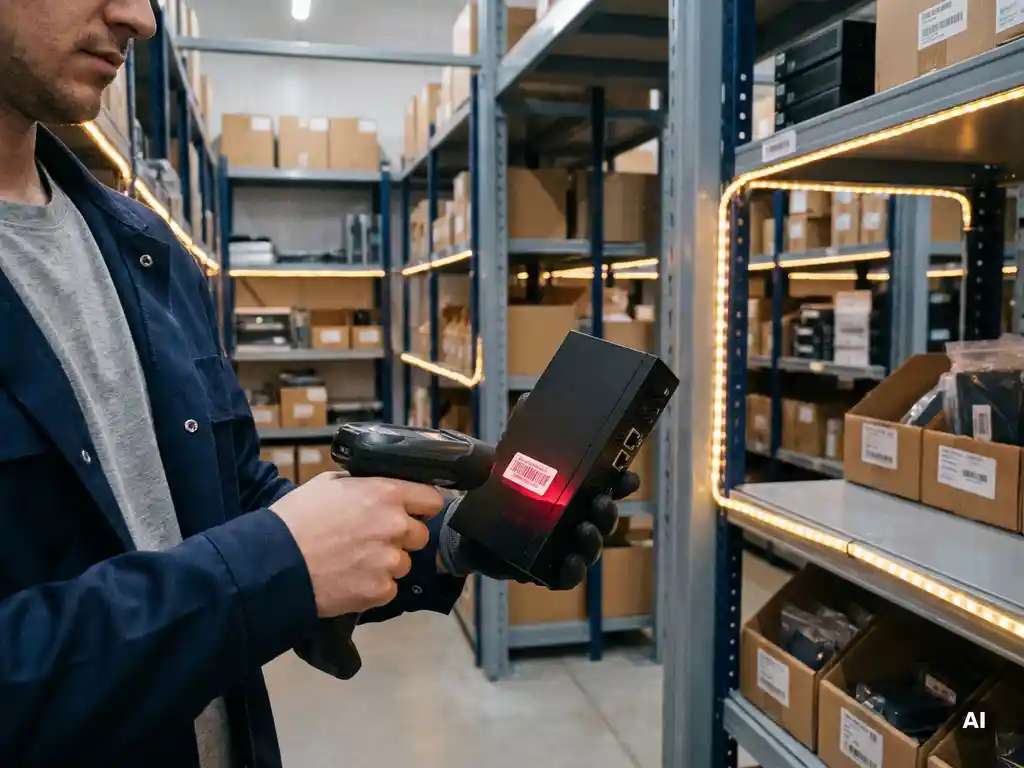
Serial number registration is important in technology fulfilment because it gives each individual device a unique, traceable identity throughout the supply chain. Without it, businesses cannot reliably track which specific unit was shipped to which customer, processed through which warehouse, or returned after use. The sections below unpack the practical questions that logistics and operations teams ask most often about serialised inventory management.
What happens to a device without a registered serial number?
Without a registered serial number, a device loses its individual identity the moment it enters a warehouse or fulfilment operation. It becomes indistinguishable from every other unit of the same model, which creates serious operational and commercial risks for businesses handling IT equipment, telecom hardware, or other technology products.
In practice, this means a warehouse cannot confirm which specific unit was picked for a particular order. If a customer reports a fault or initiates a return, there is no reliable way to verify whether the returned item is the same device that was originally shipped. This creates disputes, increases the risk of fraud, and complicates warranty administration. For high-value equipment such as routers, modems, or medical devices, the financial consequences of poor traceability can be significant.
From an inventory perspective, unregistered devices are typically managed as interchangeable stock. While this may work for low-value consumables, it is inadequate for serialised technology products where individual device history matters. Firmware versions, configuration states, repair records, and ownership data are all tied to the serial number. Without registration, that information is simply lost.
How does serial number registration work in a fulfilment warehouse?
Serial number registration in a fulfilment warehouse works by scanning and recording each device’s unique serial number at one or more defined points in the logistics process, linking it to a specific stock location, order, or customer record within a warehouse management system. This creates a product-level audit trail that persists throughout the device’s time in the warehouse.
The process typically begins at goods receipt. When a shipment arrives, warehouse staff scan each unit individually rather than simply counting cartons or pallets. The serial number is recorded alongside other relevant data such as product type, condition, and storage location. From that point forward, every movement of that device, whether it is transferred to a different zone, picked for an order, or returned by a customer, is logged against its serial number.
At the point of despatch, the serial number is confirmed against the outbound order before the package is sealed. This step closes the loop: the warehouse management system can now confirm exactly which serial number was sent to which customer, on which date, via which carrier. For technology fulfilment operations, this level of precision is what separates serialised inventory management from basic stock counting.
What types of technology products require serial number tracking?
Serial number tracking is required for any technology product where individual device identity matters commercially, technically, or legally. This broadly includes networking equipment, telecom hardware, IT devices, medical technology, and consumer electronics sold or distributed through B2B channels.
More specifically, the following categories consistently benefit from serialised inventory management:
- Telecom and connectivity hardware: Routers, modems, set-top boxes, IP telephones, and DECT systems are often provisioned with customer-specific configurations. Serial number tracking allows operators to link a device to a subscriber account from the moment it leaves the warehouse.
- Networking and IT equipment: Switches, access points, and servers carry firmware and configuration data tied to individual units. IT equipment fulfilment without serial tracking makes configuration management unreliable.
- Medical and healthcare technology: Devices such as AED units or monitoring equipment are subject to strict traceability requirements. Serial numbers support recall management and product history documentation.
- Refurbished or remanufactured devices: When a device has been repaired or restored, its serial number is the only reliable way to verify its service history and current condition before redistribution.
- High-value accessories and peripherals: Items with meaningful warranty or insurance implications benefit from individual registration even when they are not the primary device in a shipment.
The common thread across all these categories is accountability. Whenever a device needs to be identified, recalled, serviced, or returned as a specific unit rather than a generic product, serial number registration is the operational foundation that makes that possible.
How does serial number registration support reverse logistics and returns?
Serial number registration supports reverse logistics by making it possible to verify, at the point of return, exactly which device has come back and what its history is. This transforms returns processing from a largely manual, error-prone activity into a structured, data-driven workflow.
When a customer returns a device, the warehouse can immediately check the incoming serial number against the original outbound record. This confirms whether the returned item matches what was originally shipped, flags any discrepancies, and provides context for the inspection that follows. A device with a known service history, configuration state, or prior repair record can be assessed far more accurately than one arriving with no traceable background.
For businesses managing large volumes of returned telecom equipment or IT hardware, this capability directly affects commercial outcomes. It reduces the risk of accepting incorrect or fraudulent returns, supports accurate condition grading, and helps determine whether a device is suitable for refurbishment, repair, or responsible disposal. Serialised data also feeds into operational reporting, giving returns managers visibility into return rates by product type, condition patterns, and reuse potential.
This is why serial number tracking is a core component of effective reverse logistics operations for technology businesses. Without it, the returns process relies on visual inspection alone, which is insufficient for complex or high-value equipment.
What’s the difference between batch tracking and serial number registration?
Batch tracking records inventory at the group level, assigning a shared identifier to a set of products produced or received together. Serial number registration records inventory at the individual device level, assigning a unique identifier to each specific unit. The key distinction is granularity: batch tracking tells you which group a product came from, while serial number registration tells you exactly which device you are dealing with.
Batch tracking is well suited to products where individual unit identity does not matter, such as cables, packaging materials, or commodity components. It allows warehouses to manage stock efficiently without the overhead of scanning every single item. For products where one unit is genuinely interchangeable with another of the same batch, this approach is practical and cost-effective.
Serial number registration becomes necessary when individual identity matters. Consider a scenario where a telecom operator deploys five hundred routers to business customers. Batch tracking can confirm that all five hundred came from the same production run, but it cannot tell you which specific router went to which customer, which unit has been returned, or which device requires a firmware update. Only serialised inventory management provides that level of control.
In practice, many technology fulfilment operations use both approaches simultaneously: batch tracking for consumables and low-value items, and serial number registration for devices, hardware, and anything with a warranty, configuration, or service history. A capable value-added logistics partner will be able to apply the appropriate tracking method based on product type and business requirements.
How BNS Data Logistics supports serial number tracking in technology fulfilment
BNS Data Logistics provides serialised inventory management as a core part of its technology fulfilment and logistics services. For businesses handling IT hardware, telecom equipment, or other electronic devices, BNS offers structured serial number registration throughout the entire logistics process, from goods receipt through to outbound despatch and returns handling.
- Product-level registration at inbound: Each device is individually scanned and registered upon arrival, creating a reliable inventory record from the first point of contact.
- Serialised order fulfilment: Outbound orders are processed with serial number confirmation at the point of picking and packing, ensuring the correct device reaches the correct customer.
- Returns verification: Returned devices are matched against original despatch records, supporting accurate condition assessment and decisions about refurbishment, repair, or disposal.
- Cosmos WMS visibility: BNS uses its proprietary Cosmos warehouse management system to maintain real-time, product-level inventory data, giving customers visibility into individual device movements and stock status.
- Technical services integration: Where devices require configuration, firmware updates, or repair, technical processing is carried out within the same operational environment, with serial number records maintained throughout.
Whether you are managing telecom equipment fulfilment, IT hardware distribution, or a returns programme for electronic devices, serialised logistics can significantly reduce operational risk and improve supply chain transparency. Contact BNS Data Logistics to discuss how serialised inventory management can be integrated into your logistics operations.
Related Articles
- How does IT equipment fulfilment differ from standard B2B fulfilment?
- How do you choose a fulfilment provider for serialized electronic devices?
- How can internet service providers manage thousands of customer-owned devices?
- How can technology companies improve the fulfilment of serialized products?
- What should internet service providers look for in a fulfilment partner?