
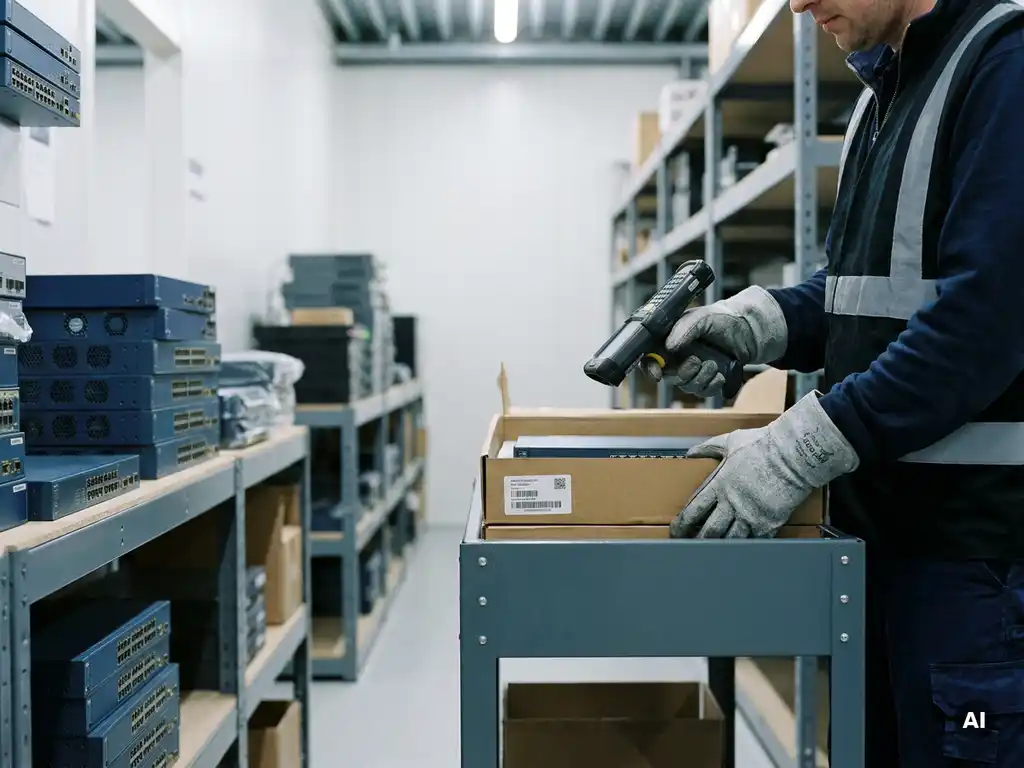
Choose a fulfilment provider for serialized electronic devices by prioritising partners with dedicated serial number tracking, a capable warehouse management system, and hands-on experience handling IT or telecom hardware. The right provider must be able to register, store, pick, and ship individual devices by serial number, not just manage stock in bulk quantities. The sections below address the most common questions buyers raise when evaluating fulfilment partners for this type of product.
What does serialized fulfilment actually require from a logistics provider?
Serialized fulfilment requires a logistics provider to track, process, and report on every individual device using its unique serial number throughout the entire warehouse operation, from goods receipt to outbound shipment. This goes well beyond standard inventory management, where products are counted in quantities. With serialized inventory management, each unit has its own identity in the system.
In practice, this means the provider’s warehouse management system must capture serial numbers at intake, link them to specific storage locations, and confirm the correct unit at every stage of picking and packing. When a router, modem, or IT hardware component leaves the warehouse, the system should record exactly which serial number was dispatched, to which order, and when.
For telecom equipment fulfilment and IT equipment fulfilment specifically, this level of traceability is not optional. Devices may carry firmware versions, configuration profiles, or warranty registrations tied to their serial number. Shipping the wrong unit, even one that is physically identical, can create downstream problems for the end customer and the operator managing the deployment.
Providers offering value-added logistics services alongside standard fulfilment are better positioned to handle this complexity, since they typically have the processes and systems in place for detailed product-level administration.
What are the risks of using a non-specialized fulfilment provider for electronic devices?
Using a non-specialised fulfilment provider for serialized electronic devices creates significant operational risks, including serial number mismatches, incorrect device shipments, lost traceability, and compliance gaps that are difficult and costly to resolve after the fact.
A general-purpose fulfilment warehouse is designed for volume throughput. Products are typically managed by SKU, meaning all units of the same product are treated as interchangeable. For electronics where individual identity matters, this approach breaks down quickly.
Common problems include:
- Devices shipped without serial number confirmation, making it impossible to verify which unit went where
- Firmware or configuration versions mixed across batches, leading to deployment failures
- Returns received without proper identification, making inspection and reintegration unreliable
- No audit trail if a device is later involved in a warranty claim, recall, or security incident
- Inability to report on stock by individual unit, preventing accurate lifecycle tracking
For businesses in telecommunications, IT distribution, or healthcare technology, these gaps carry real consequences. A telecom operator deploying customer premises equipment, for example, needs to know exactly which device is at which address. Without serial number tracking at the fulfilment stage, that visibility is lost from the very first step.
What questions should you ask a fulfilment provider about serialized tracking?
When evaluating a fulfilment partner for serialized electronic devices, ask directly about their warehouse management system’s serial number capabilities, how they handle intake scanning, what data is captured per unit, and how that information is reported back to you in real time.
A structured set of questions will quickly separate capable providers from those who handle serialization as an afterthought:
- Does your WMS register serial numbers at goods receipt, or only at dispatch? Ideally both, with confirmation at every transfer point in between.
- Can you provide a serial-number-level stock report on demand? This is the baseline for inventory visibility with serialized products.
- How do you handle serial number discrepancies between the delivery note and the physical shipment? The answer reveals how rigorous the intake process actually is.
- Can your system link a serial number to an outbound order and a return? End-to-end traceability depends on this connection.
- What happens if a serial number is damaged or missing on arrival? The process for handling exceptions shows operational maturity.
- Do you support product-level reporting through an API or customer portal? For B2B order fulfilment services at scale, self-service access to data is important.
Providers who answer these questions confidently and with specific process detail are far more likely to manage your products accurately than those who treat serialization as a minor configuration in a general system.
How does reverse logistics work for serialized electronic devices?
Reverse logistics for serialized electronic devices involves receiving returned units, scanning and re-registering each serial number, assessing the device’s condition, and routing it to the appropriate next step, whether that is restocking, repair, refurbishment, or responsible disposal.
The process begins when a return is initiated. For B2B operations, this typically follows a structured returns authorisation process. When the device arrives at the warehouse, it should be scanned immediately so the system can match the returned unit to its original outbound record. This is where serialized tracking proves its value: the provider knows exactly which device has come back, its history, and what condition it was expected to be in.
After intake, the device goes through inspection. Depending on its condition and the client’s instructions, the outcome might be:
- Direct reintegration into available stock if the device is undamaged and meets quality criteria
- Technical assessment and repair before restocking
- Cosmetic restoration or refurbishment to extend the product’s usable life
- Quarantine for further investigation or client decision
Effective reverse logistics for electronic devices requires the same serial-number-level discipline as outbound fulfilment. Without it, returned devices become unidentified stock, and the opportunity to recover product value is significantly reduced. For telecom operators and IT distributors managing high volumes of returned equipment, this translates directly into cost and sustainability impact.
Which fulfilment capabilities matter most for telecom and IT hardware specifically?
For telecom and IT hardware, the fulfilment capabilities that matter most are serialized inventory management, device configuration and firmware handling, precise inbound quality checks, and the ability to integrate technical preparation directly into the logistics workflow.
Standard e-commerce fulfilment handles identical units interchangeably. Telecom equipment fulfilment and IT equipment fulfilment operate differently because the products themselves carry configuration data, firmware versions, and deployment requirements that affect how they function in the field.
Key capabilities to look for include:
- Serial number tracking at every stage: From goods receipt through storage, picking, dispatch, and returns, with a full audit trail.
- Device configuration support: The ability to install configuration files or update firmware before dispatch, so devices arrive deployment-ready. These technical services reduce the time between delivery and live operation.
- Inbound inspection and quantity verification: Particularly important for hardware arriving from multiple suppliers or international shipments.
- Flexible order types: Support for individual unit orders, bulk pallet shipments, and field technician deliveries, often within the same operation.
- Returns processing with condition grading: Returned devices need to be assessed and routed correctly, not simply received into a general returns pile.
- Real-time inventory visibility: A warehouse management system that provides product-level stock data, not just aggregate quantities.
For businesses scaling their technology fulfilment operations across Europe, the combination of these capabilities within a single fulfilment partner significantly reduces operational complexity compared to managing multiple providers with different systems and processes.
How BNS Data Logistics supports fulfilment for serialized electronic devices
BNS Data Logistics provides specialist B2B fulfilment and product lifecycle services for companies managing serialized electronic devices, including telecom hardware, IT equipment, networking products, and healthcare technology. Our operations are built around product-level traceability using Cosmos, our proprietary warehouse management system.
Specifically, we support businesses with:
- Serial number registration at intake and throughout the warehouse process, giving you an accurate, real-time view of exactly which devices are in stock, where they are, and where they have been
- Device configuration and firmware preparation integrated directly into the fulfilment workflow, so hardware leaves the warehouse ready for deployment
- Structured inbound quality and quantity checks to catch discrepancies before they affect your inventory records or customer deliveries
- Returns processing and condition assessment for returned electronic devices, with options for repair, refurbishment, or reintegration depending on product condition
- Flexible fulfilment for B2B order types, from individual unit dispatch to bulk pallet shipments and field technician deliveries
- Operational reporting through Cosmos, providing inventory visibility at the serial number level without requiring manual reconciliation
Whether you are a telecom operator managing customer premises equipment, an IT distributor scaling your logistics operations, or a hardware business looking to outsource fulfilment to a specialist partner in Europe, we would be glad to discuss how our services align with your requirements.
Contact BNS Data Logistics via our contact page to speak with our team about your serialized fulfilment needs.
Related Articles
- How can international companies distribute IT equipment across Europe without their own warehouse?
- What fulfilment services do telecom equipment manufacturers need?
- How can technology companies maintain real-time visibility of outsourced inventory?
- How does serialized inventory management improve supply chain visibility?
- How can serial number tracking improve the distribution of telecom equipment?