
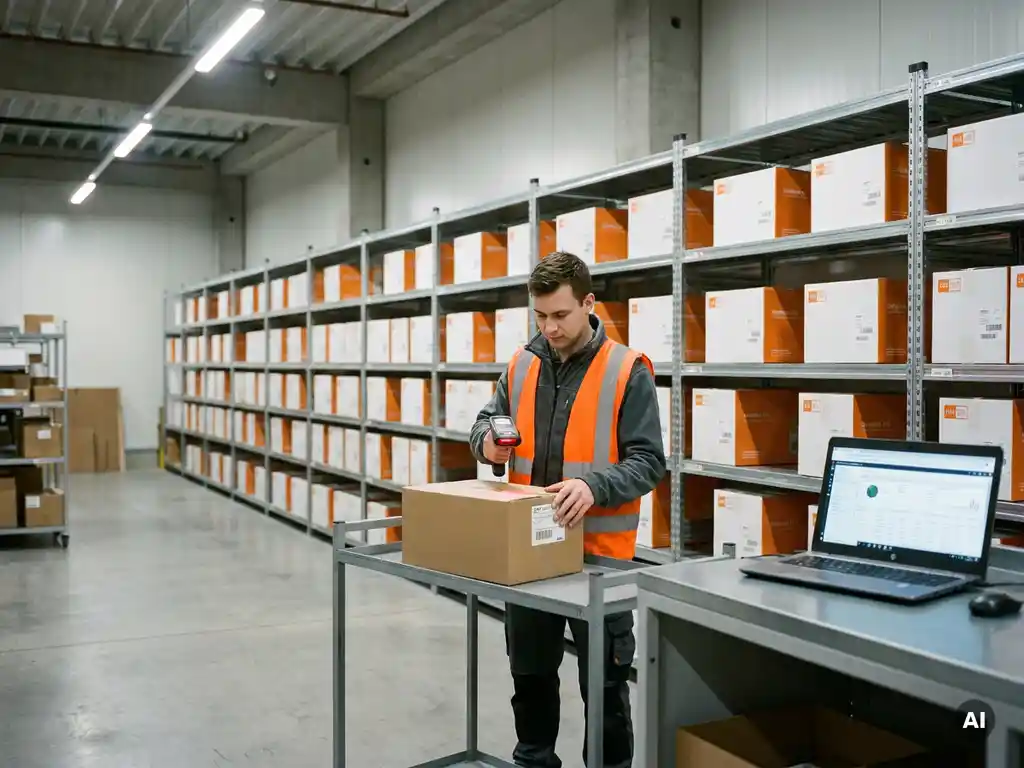
Technology companies can improve the fulfilment of serialised products by implementing serial number tracking at every stage of the logistics process, from goods receipt through to outbound delivery and returns. This requires a combination of structured warehouse procedures, a capable warehouse management system, and clearly defined processes for handling individual product identities rather than bulk stock. The sections below address the most common questions about serialised fulfilment in practice.
What makes serialised product fulfilment more complex than standard fulfilment?
Serialised product fulfilment is more complex than standard fulfilment because every individual unit must be tracked, registered, and managed by its unique serial number throughout the entire logistics process. Unlike standard fulfilment, where products of the same SKU are treated as interchangeable, serialised fulfilment requires that each item maintains its own identity from inbound receipt to outbound delivery.
In standard fulfilment, a warehouse might receive 500 identical routers and simply add them to a shared stock count. In serialised fulfilment, each of those 500 routers has a unique serial number that must be scanned, registered, stored against a specific location, picked individually, and recorded at the point of despatch. This applies equally to telecom equipment fulfilment and IT equipment fulfilment, where regulatory requirements, warranty conditions, or customer-specific configurations make individual unit traceability essential.
The practical consequences are significant. Receiving takes longer, picking requires additional scanning steps, and errors are more visible because every discrepancy is tied to a specific unit. Staff training requirements are higher, and the margin for process shortcuts is much smaller. Any warehouse handling serialised technology products must be built around these constraints from the outset, rather than adapting a standard fulfilment operation after the fact.
How does serialised inventory tracking work in a warehouse?
Serialised inventory tracking works by assigning each physical product unit a unique identifier, typically its manufacturer serial number or an additional barcode, and recording every movement of that unit within the warehouse management system. At each stage, a scan links the product’s identity to a specific action, location, or order, creating a complete audit trail.
The process typically follows these steps:
- Inbound registration: When stock arrives, each unit is scanned individually. The serial number is recorded against the purchase order, supplier reference, and storage location.
- Location assignment: The system assigns the unit to a specific bin, shelf, or pallet position. Any movement to a different location is recorded with a new scan.
- Order picking: When an order is processed, the picker scans the specific unit allocated to that order, confirming the correct serial number is being despatched.
- Outbound confirmation: The serial number is linked to the shipment record, the customer order, and the carrier label before the item leaves the warehouse.
- Reporting and visibility: At any point, the system can confirm exactly where a specific unit is, which order it was assigned to, and what its current status is.
For technology companies managing modems, routers, IP phones, or medical devices, this level of granularity is not optional. It supports warranty management, regulatory compliance, and the ability to respond accurately to customer queries about specific units. Effective serialised inventory management at the warehouse level is what makes all of this possible in practice.
What systems and integrations do technology companies need for serialised fulfilment?
Technology companies handling serialised products need a warehouse management system capable of product-level tracking, combined with integrations that connect inventory data to their order management, ERP, and customer-facing platforms. Without these connections, serial number data remains isolated and loses much of its operational value.
The warehouse management system is the core requirement. It must support serial number registration at goods receipt, location-level tracking, and serial-number-confirmed picking. Not all warehouse management systems offer this natively, and companies evaluating a fulfilment partner in Europe should verify that serialised processing is a standard capability, not a custom workaround.
Beyond the WMS, the following integrations are typically necessary:
- ERP or order management system: Orders placed in the ERP must trigger picking instructions in the WMS, and the despatched serial number must flow back to the ERP for invoicing and warranty registration.
- E-commerce platform: For businesses selling technology products online, the fulfilment system must receive order data automatically and confirm despatch with serial number details.
- Customer portals or reporting dashboards: Many B2B customers need visibility into which serial numbers have been delivered to them, particularly for asset management or compliance purposes.
- Carrier systems: Outbound shipping integrations must link the carrier tracking number to the specific serial number despatched, enabling end-to-end traceability.
The complexity of these integrations should not be underestimated. Companies often discover that their existing systems were not designed with serialised fulfilment in mind, which creates gaps in data flow that require either system development or a change of logistics partner.
How does serialisation affect returns processing and reverse logistics?
Serialisation significantly improves the accuracy and efficiency of returns processing because every returned unit can be immediately identified, matched to its original outbound record, and assessed against its known history. Without serial number tracking, returns handling relies on visual inspection and customer-provided information, which is far less reliable.
When a serialised product is returned, the first step is scanning the serial number to retrieve its complete history: when it was received, which order it was despatched on, which customer received it, and whether any technical work was performed on it. This information directly informs the returns decision, including whether the unit is eligible for refurbishment, repair, or disposal.
For telecom operators and IT distributors managing large volumes of returned equipment, this matters considerably. A returned modem with a known configuration history can be assessed and reintegrated into stock far more efficiently than one with no traceable background. Serialised reverse logistics also supports accurate credit processing, warranty claim validation, and fraud prevention, since the system can flag units that were not part of the original outbound shipment.
The connection between serialisation and returns quality is direct: the more complete the outbound tracking, the more useful the data is when a product comes back. Companies that invest in serialised fulfilment from the outset find that their reverse logistics operations become measurably more structured as a result.
When should a technology company outsource serialised fulfilment to a specialist?
A technology company should consider outsourcing serialised fulfilment to a specialist when the operational complexity of serial number tracking, technical preparation, and returns management exceeds what an in-house team can handle efficiently, or when the investment required to build that capability internally outweighs the benefits of owning it.
Several specific situations typically signal that outsourcing makes sense:
- Growing order volumes: When the number of serialised units being processed increases faster than internal warehouse capacity or staffing can accommodate.
- Technical preparation requirements: When products require configuration, firmware updates, or assembly before despatch, and combining these steps with logistics in-house creates bottlenecks. Integrating technical services with fulfilment reduces unnecessary handling and shortens lead times.
- Returns complexity: When returned product volumes are high enough that managing inspection, diagnostics, and reintegration in-house becomes a significant operational burden.
- System limitations: When the current WMS does not support serialised tracking at the required level and the cost of upgrading or replacing it is prohibitive.
- Lack of specialist expertise: When the internal team does not have experience with serialised inventory management and the learning curve is affecting service quality.
Outsourcing to a B2B fulfilment specialist with proven experience in technology products means gaining access to established processes, capable systems, and trained staff without building that infrastructure from scratch. The key is choosing a partner whose capabilities genuinely match the product type and the level of traceability required, rather than a general logistics provider that treats serialised products as a variation on standard stock.
How BNS Data Logistics supports serialised technology fulfilment
BNS Data Logistics provides specialist fulfilment and logistics services for technology companies that need reliable, product-level tracking across their supply chain. Our operations are built around the requirements of serialised products, including IT hardware, telecom equipment, networking devices, and healthcare technology.
- Serial number registration and tracking: Every product is registered individually at goods receipt and tracked through our proprietary Cosmos warehouse management system, providing full visibility from inbound to outbound and through returns.
- Integrated technical services: We combine device configuration, firmware updates, and assembly with logistics operations, reducing handling steps and preparing equipment for deployment before it leaves our facility.
- Structured returns management: Our reverse logistics process uses serial number data to assess returned units accurately, supporting repair, refurbishment, or reintegration decisions based on each product’s history.
- B2B order fulfilment: We handle individual orders, bulk shipments, and palletised deliveries for technology suppliers, distributors, and telecom operators, maintaining serialised traceability throughout.
- Reporting and inventory visibility: Through Cosmos, customers gain access to real-time inventory data and product movement information, supporting their own reporting and compliance requirements.
If your business is managing serialised technology products and needs a logistics partner with the processes and systems to handle them correctly, we would be glad to discuss your requirements. Contact BNS Data Logistics to start the conversation.