
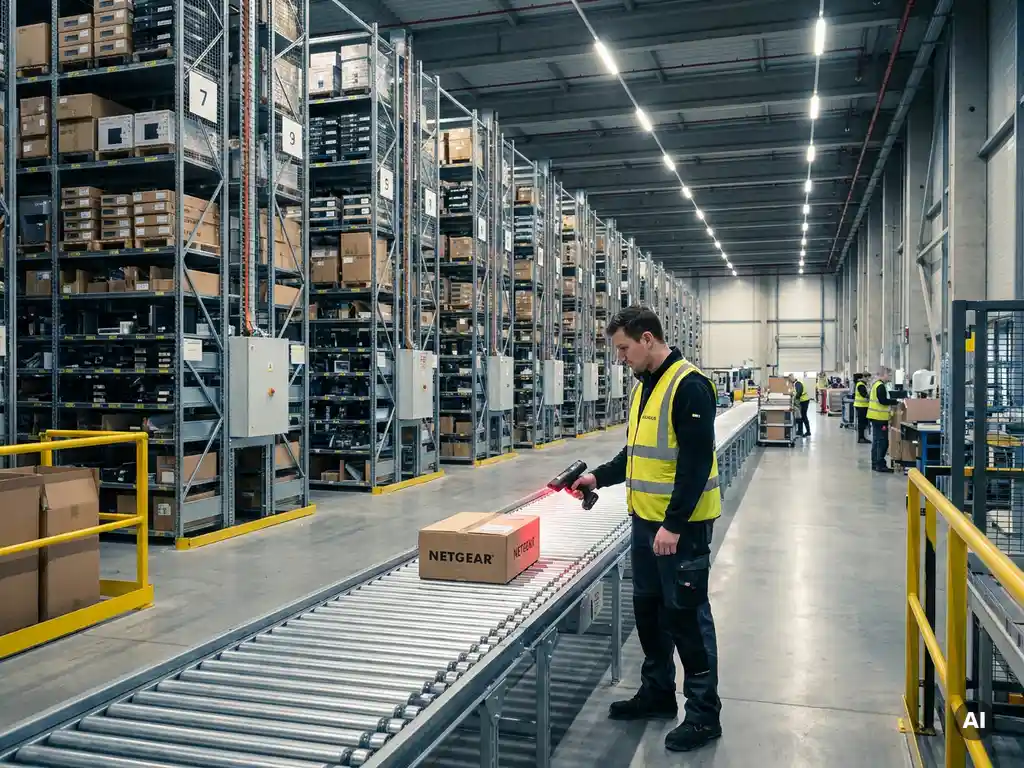
Technology manufacturers can outsource warehousing and order fulfilment in Europe by partnering with a third-party logistics (3PL) provider that specialises in technology products. The right partner handles inbound shipments, secure storage, serialised inventory management, order processing, and outbound distribution on your behalf. This article covers the key questions technology manufacturers typically ask before making that decision.
What logistics services do European 3PL providers offer technology manufacturers?
European 3PL providers offer technology manufacturers a range of services that cover the full product journey, from goods receipt and warehousing through to order fulfilment, distribution, and returns management. Providers that specialise in technology logistics also offer value-added services such as serialised inventory tracking, device configuration, repackaging, and labelling, capabilities that general fulfilment warehouses rarely provide.
For IT hardware and telecom equipment manufacturers specifically, the most relevant services typically include:
- Inbound logistics: Coordinating the receipt of bulk shipments, performing quantity and quality checks, and registering products at the individual unit level
- Secure warehousing: Storing high-value hardware in controlled environments with product-level traceability
- Serial number tracking: Registering and tracking individual devices by serial number throughout storage and distribution
- Order fulfilment: Picking, packing, and shipping orders to business customers, resellers, or end users
- Value-added logistics: Barcode labelling, co-packing, palletisation, and customised packaging preparation
- Technical services: Device configuration, firmware updates, and assembly prior to shipment
- Reverse logistics: Managing returned equipment, including inspection, sorting, and reintegration where appropriate
The breadth of services varies significantly between providers. Technology manufacturers should look for a 3PL that integrates these capabilities within a single operational framework, rather than relying on multiple vendors for different parts of the process.
How does outsourcing warehousing work for technology manufacturers?
Outsourcing warehousing works by transferring physical storage, inventory management, and order processing responsibilities to a 3PL provider. The manufacturer ships stock to the 3PL’s facility, where it is received, registered, and stored. When an order is placed, the 3PL picks, packs, and ships the product on the manufacturer’s behalf, maintaining real-time inventory records throughout.
For technology manufacturers, the process typically begins with an onboarding phase in which the 3PL aligns its warehouse management system (WMS) with the manufacturer’s ordering and inventory systems. Products are registered individually, often by serial number, so every unit can be traced from the moment it arrives in the warehouse to the moment it leaves.
Day-to-day operations then run largely without manufacturer involvement. The 3PL handles inbound shipments from factories or distributors, manages stock levels, processes B2B orders or webshop orders, and coordinates outbound delivery. Manufacturers typically access inventory data and order status through a WMS portal or reporting dashboard, giving them visibility without requiring hands-on warehouse management.
This model is particularly well suited to companies experiencing growth, seasonal demand fluctuations, or limited internal warehouse capacity. Rather than investing in additional infrastructure, manufacturers can scale storage and fulfilment capacity through their 3PL partner as volumes change.
What should technology manufacturers look for in a European fulfilment partner?
Technology manufacturers should look for a European fulfilment partner with demonstrated experience handling IT hardware, telecom equipment, or similar high-value electronics, not just general consumer goods. The key criteria are serialised inventory management, a capable warehouse management system, technical services integration, and the ability to handle B2B order fulfilment at the required scale.
Beyond core capabilities, the following factors are worth evaluating carefully:
- Serialised inventory management: The ability to register, track, and report on individual units by serial number is essential for technology products. Without this, manufacturers lose visibility over specific devices in storage and distribution.
- Warehouse management system: A modern WMS should provide real-time inventory data, order tracking, and reporting. Confirm whether the system integrates with your existing ERP, e-commerce platform, or ordering tools.
- Technical capabilities: If products require configuration, firmware installation, or assembly before shipment, look for a partner that integrates technical services directly into the logistics workflow.
- Returns handling: A structured approach to reverse logistics reduces the cost and complexity of managing returned equipment.
- Quality certifications: ISO 9001 (quality management), ISO 27001 (information security), and ISO 14001 (environmental management) indicate a provider with structured, audited processes.
- Scalability: The partner should be able to accommodate volume growth without requiring significant lead time or renegotiation.
It is also worth assessing how transparent the provider is about its processes and pricing. Fragmented reporting and unclear cost structures are common pain points when working with logistics partners, and they are worth addressing before signing an agreement.
Which European countries are the best locations for a technology fulfilment hub?
The Netherlands, Belgium, and Germany are consistently the strongest locations for a European technology fulfilment hub, due to their central geography, port infrastructure, and well-developed logistics networks. The Netherlands in particular, home to the Port of Rotterdam and Amsterdam Airport Schiphol, offers direct access to the majority of the European market within one to two days by road.
Each location has distinct advantages depending on the manufacturer’s priorities:
- The Netherlands: Excellent connectivity to Western and Central Europe, strong logistics infrastructure, and a well-established ecosystem of specialised 3PL providers. Particularly well suited for manufacturers distributing to the Benelux, Germany, and the UK.
- Belgium: The Port of Antwerp is one of Europe’s largest cargo ports, and Belgium offers fast access to France, Germany, and the Netherlands. A strong option for manufacturers with significant freight volumes arriving by sea.
- Germany: The largest consumer market in Europe and a central distribution point for Eastern and Southern Europe. Useful for manufacturers with high volumes destined for German-speaking markets.
- Poland: An increasingly popular location for manufacturers looking to serve Eastern European markets cost-effectively, with lower operating costs than Western European alternatives.
The right choice depends on where the majority of end customers are located, how products enter Europe (by air, sea, or road), and whether the manufacturer needs a single hub or a distributed network. For most technology manufacturers serving Western Europe, a Netherlands-based fulfilment operation offers a practical and well-connected starting point.
How do returns and reverse logistics work when outsourcing to a European 3PL?
When outsourcing to a European 3PL, returns and reverse logistics work through a structured process in which the 3PL receives returned equipment, inspects and assesses each unit, and then determines the appropriate next step, whether that is reintegration into stock, repair, refurbishment, or disposal. The manufacturer retains visibility through reporting provided by the 3PL’s warehouse management system.
For technology manufacturers, the reverse logistics process typically involves more complexity than standard consumer returns. Individual devices need to be identified by serial number, assessed for condition and functionality, and processed according to predefined criteria. A 3PL experienced in reverse logistics for technology products will have structured workflows for this, rather than treating all returns as identical.
The practical steps generally include:
- Returns receipt: The 3PL receives returned units and logs them against the original shipment or order record
- Inspection and condition assessment: Each unit is checked for physical damage, completeness, and functionality
- Sorting and decision-making: Products are categorised based on condition: resaleable, repairable, or requiring disposal
- Technical processing (where applicable): Devices suitable for reuse may undergo diagnostics, repair, or cosmetic restoration before being returned to available inventory
- Reporting: The manufacturer receives data on returned volumes, condition outcomes, and inventory status
Not every returned product can be refurbished or resold. The outcome depends on the condition of the equipment and the manufacturer’s own product policies. A capable 3PL will make this process transparent and provide the data needed to make informed decisions about returned stock.
How BNS Data Logistics supports technology manufacturers with European fulfilment
BNS Data Logistics provides specialised logistics and fulfilment services for technology manufacturers, IT hardware distributors, and telecommunications equipment suppliers operating in Europe. Based in Vianen, the Netherlands, BNS combines warehousing, order fulfilment, technical services, and reverse logistics within a single operational framework.
For technology manufacturers looking to outsource their European logistics operations, BNS offers:
- Serialised inventory management: Individual product registration and serial number tracking through the Cosmos warehouse management system, providing real-time visibility over stock and order status
- B2B order fulfilment: Picking, packing, and distribution of IT hardware, telecom equipment, and electronic devices to business customers and resellers across Europe
- Value-added logistics: Barcode labelling, repackaging, co-packing, and palletisation to prepare products for distribution or retail
- Technical services: Device configuration, firmware updates, and component assembly integrated directly into the logistics workflow, reducing handling time and improving product readiness
- Reverse logistics and returns management: Structured processing of returned equipment, including inspection, condition assessment, and refurbishment where appropriate
- ISO-certified operations: Quality, information security, and environmental management certified to ISO 9001, ISO 27001, and ISO 14001 standards
If you are evaluating logistics partners for your European fulfilment operations, contact BNS Data Logistics to discuss your requirements and find out how we can support your supply chain.
Related Articles
- What are the benefits of integrating warehousing, fulfilment and device tracking?
- How can businesses track which electronic devices were delivered to each customer?
- How does IT equipment fulfilment differ from standard B2B fulfilment?
- What fulfilment services do telecom equipment manufacturers need?
- Why is specialized fulfilment important for high-value electronic equipment?