
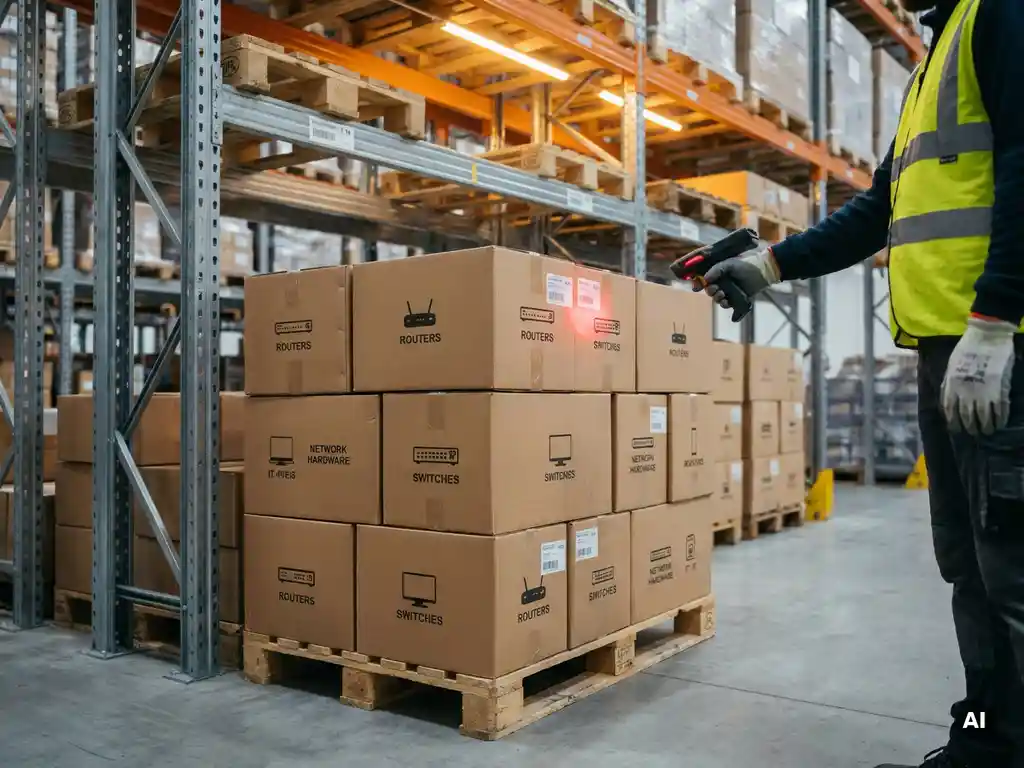
A warehouse management system improves the accuracy of IT equipment distribution by enabling product-level tracking, serialised inventory registration, and automated verification at every stage of the fulfilment process. Rather than relying on manual records or batch-level stock counts, a WMS gives operations teams precise visibility over individual devices from the moment they arrive in the warehouse to the moment they leave for a customer. The sections below address the most common questions IT distributors and technology fulfilment managers ask when evaluating or implementing a WMS.
What causes inaccuracies in IT equipment distribution?
Inaccuracies in IT equipment distribution most commonly arise from manual data entry, insufficient product-level tracking, and fragmented processes across receiving, storage, and dispatch. Unlike general merchandise, IT hardware often involves individual serial numbers, specific firmware versions, and configuration requirements, all of which create more opportunities for error when processes rely on paper records or generic stock counts.
Several compounding factors make technology fulfilment particularly prone to mistakes:
- Batch-level inventory management: When stock is recorded by SKU quantity rather than by individual device, it becomes impossible to confirm which specific unit has been picked or shipped. This creates mismatches between what the system says is in stock and what is physically available.
- Manual receiving processes: If inbound shipments are checked against paper manifests without scanning individual items, discrepancies between ordered and delivered quantities go undetected until a customer reports a problem.
- Poorly defined storage locations: Without structured bin or location assignments, warehouse staff spend time searching for products, increasing the likelihood of picking the wrong item or the wrong variant.
- Disconnected systems: When a warehouse operates separately from order management or ERP systems, stock updates are delayed or incomplete, leading to overselling, incorrect picking lists, and shipping errors.
- Inadequate returns processing: Returned devices that re-enter stock without inspection or re-registration introduce inaccurate inventory data and risk sending faulty or incorrectly configured hardware to the next customer.
For telecom equipment fulfilment in particular, where a router or modem must carry the correct firmware and configuration before dispatch, a single process gap can result in a non-functional device reaching an end user. The stakes are higher than in general consumer goods distribution, which is why structured, technology-supported processes matter significantly.
How does a WMS track individual IT devices through a warehouse?
A warehouse management system tracks individual IT devices by registering each unit against its unique serial number at inbound receiving and then recording every subsequent movement (putaway, pick, pack, and dispatch) against that same identifier. This creates a complete, auditable history for each device, making it possible to confirm exactly where a product is, what condition it is in, and where it has been at any point in the process.
The tracking process typically works as follows. When a shipment arrives, warehouse staff scan each device individually. The WMS registers the serial number, links it to the relevant purchase order or inbound manifest, and assigns it a storage location. From that point, every warehouse action (moving the device to a different location, allocating it to an order, picking it, or processing it through a technical step) is recorded against the same serial number.
At the point of dispatch, the WMS verifies that the device being packed matches the serial number allocated to the outbound order. If there is a discrepancy, the system flags it before the shipment leaves the building. This kind of serialised inventory management eliminates the guesswork that causes costly shipping errors in B2B order fulfilment services, where sending the wrong device to a network deployment or a healthcare technology customer can have significant downstream consequences.
For IT distributors managing large volumes of similar-looking hardware (routers, modems, switches, IP phones), serial number tracking is not a luxury. It is the only reliable way to maintain product-level accuracy across a busy warehouse operation.
What WMS features matter most for IT hardware fulfilment?
The WMS features that matter most for IT hardware fulfilment are serialised inventory management, location-based stock control, directed picking, system integration capabilities, and real-time reporting. These functions address the specific challenges of technology product distribution, where individual device identity, configuration status, and delivery accuracy are all critical.
Serialised inventory and location management
The ability to register and track products by serial number is the single most important WMS feature for IT and telecom equipment fulfilment. Without it, a warehouse can only confirm that a certain quantity of a product exists, not which specific units are in stock, which have been allocated, or which have already shipped. Location management ensures that every unit is assigned a precise bin or shelf position, reducing search time and eliminating the pick errors that come from disorganised storage.
Directed picking and verification
Directed picking guides warehouse staff to the correct location and prompts them to scan the item before confirming the pick. This removes reliance on memory or paper lists and creates a real-time check that the right product is being selected. For technology fulfilment, where product variants may look identical but carry different firmware or configuration profiles, this verification step is essential. Combined with packing confirmation, it ensures that what leaves the warehouse matches what was ordered.
Integration and reporting capabilities
A WMS that operates in isolation from order management, ERP, or customer portals creates data gaps that undermine accuracy. Integration capabilities allow stock levels, order statuses, and shipment confirmations to flow between systems automatically, reducing manual re-entry and the errors that come with it. Real-time reporting gives operations managers visibility into inventory movements, picking performance, and exception rates, the data needed to identify where inaccuracies occur and address them before they escalate.
How does a WMS reduce picking and shipping errors for technology products?
A WMS reduces picking and shipping errors for technology products by replacing manual, judgment-based processes with system-guided, scan-verified workflows. At each stage (pick, pack, and dispatch), the system confirms that the correct item is being handled before allowing the process to continue, creating a series of automated checkpoints that catch mistakes before they reach the customer.
In practice, this means a picker receives a directed task to a specific location, scans the item at that location, and the WMS validates the serial number against the allocated order line. If the scanned item does not match, the system immediately alerts the operator. This approach is far more reliable than paper pick lists, where a staff member might select the correct product type but the wrong unit, or miss a variant difference entirely.
At the packing stage, a second scan confirms that every item going into a shipment matches the order. For B2B fulfilment of IT hardware, where a single order might contain multiple device types with different configurations, this multi-point verification is particularly valuable. It also creates a documented record that can be referenced if a customer raises a query about what was shipped.
Shipping label generation within the WMS further reduces errors by linking the correct carrier service, delivery address, and shipment documentation to the verified order automatically. This removes the risk of a manually created label being applied to the wrong parcel, a straightforward mistake that becomes expensive when the product is high-value networking equipment or medical technology hardware.
When should an IT distributor integrate a WMS with other business systems?
An IT distributor should integrate a WMS with other business systems as soon as the volume or complexity of operations makes manual data transfer between platforms a regular source of delay or error. For most technology distributors, this point arrives earlier than expected, often when order volumes grow, product variants multiply, or customer reporting requirements become more detailed than a standalone WMS can support.
The most common and valuable integrations for IT hardware fulfilment are with ERP systems, order management platforms, and carrier or shipping systems. An ERP integration ensures that stock levels in the WMS are immediately reflected in financial and procurement records, preventing overselling and enabling accurate replenishment planning. Order management integration means that customer orders flow directly into the WMS without manual re-entry, reducing processing time and the risk of transcription errors.
Carrier integration automates label generation, tracks shipment status in real time, and feeds delivery confirmations back into the order record. For a fulfilment partner managing B2B order fulfilment services across multiple customers and carriers, this level of automation is necessary to maintain accuracy at scale.
Integration with customer portals or reporting dashboards is also worth considering for distributors serving telecom operators or enterprise IT buyers who require visibility into their own inventory and order status. Providing that transparency through system integration, rather than manual reporting, reduces administrative workload and improves the reliability of the information customers receive.
The right moment to integrate is before operational complexity outpaces manual management, not after errors have already become a recurring problem.
How BNS Data Logistics supports accurate IT equipment distribution
BNS Data Logistics provides IT hardware fulfilment and technology logistics services designed specifically for the accuracy and traceability requirements that B2B technology distribution demands. For companies managing routers, modems, networking equipment, or other serialised hardware, BNS offers a structured operational environment built around product-level control.
- Serialised inventory management through Cosmos: BNS uses its proprietary Cosmos warehouse management and product information system to register and track individual devices by serial number from inbound receipt through to outbound dispatch, providing full traceability at every stage.
- Scan-verified picking and packing: Every pick and pack operation is verified against the allocated order, reducing shipping errors and ensuring the correct device reaches the correct destination.
- Value-added logistics services: BNS provides value-added services including barcode and QR-code labelling, repackaging, and co-packing, supporting accurate product identification and preparation before distribution.
- Technical services integrated into fulfilment: Where devices require configuration, firmware updates, or functional checks before dispatch, BNS performs these technical services within the same operational flow, avoiding unnecessary handling steps and reducing the risk of incorrectly prepared hardware reaching customers.
- Reverse logistics and returns processing: Returned equipment is inspected, assessed, and re-registered before re-entering stock, maintaining inventory accuracy and preventing faulty or unchecked devices from being reallocated. Learn more about BNS’s reverse logistics services.
- Real-time reporting and inventory visibility: Customers have access to current stock information and product movement data through the Cosmos platform, supporting informed decision-making and reducing the need for manual stock reconciliation.
If your business handles IT hardware, telecom equipment, or other serialised technology products and you want to improve distribution accuracy and operational visibility, contact BNS Data Logistics to discuss your requirements.
Related Articles
- What are the advantages of real-time inventory reporting for telecom operators?
- What are the benefits of integrating warehousing, fulfilment and device tracking?
- How does serialized inventory management improve supply chain visibility?
- How can technology manufacturers outsource warehousing and order fulfilment in Europe?
- How can technology companies improve the fulfilment of serialized products?