
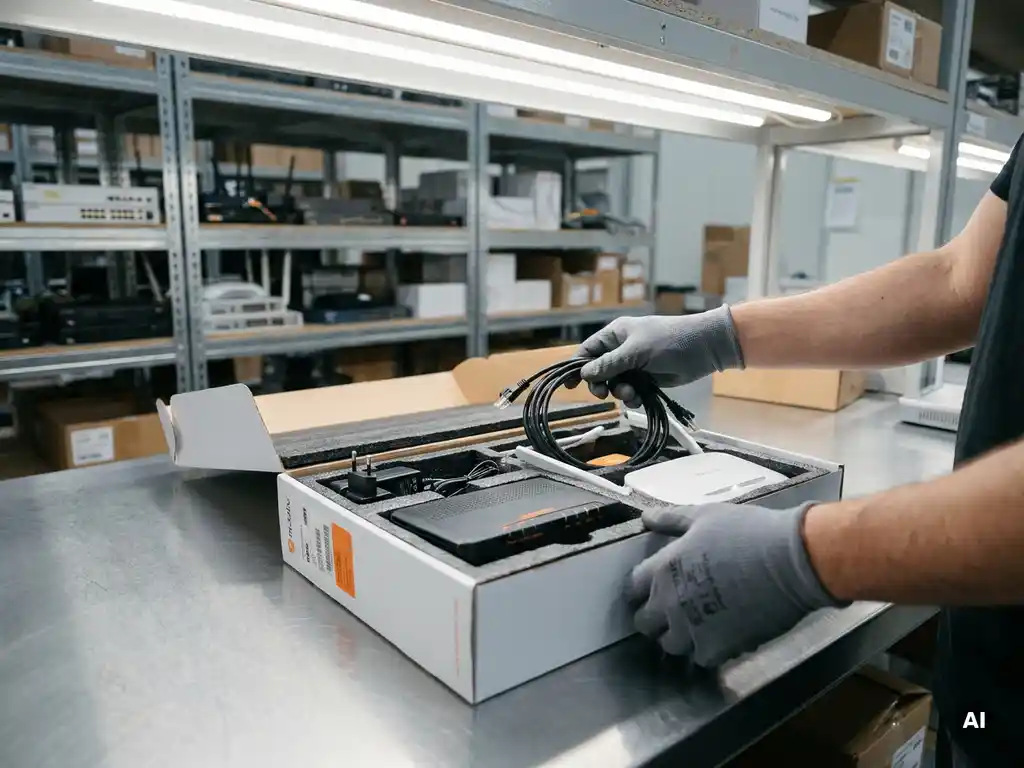
Product kitting for modems, routers, and network equipment means assembling all the components a customer needs into a single, ready-to-deploy package before it leaves the warehouse. For telecom operators, internet service providers, and IT hardware distributors, kitting is a core part of technology fulfilment that reduces installation errors, shortens deployment timelines, and improves the end-user experience. The sections below answer the most common operational questions about how kitting works for network hardware at scale.
What components are typically included in a modem or router kit?
A standard modem or router kit includes the primary device, its power adapter, one or more network cables, a quick-start guide or installation manual, and any mounting hardware required for installation. Depending on the customer’s deployment specification, a kit may also include pre-printed labels, SIM cards, coaxial cables, or branded packaging inserts.
The exact contents depend on the deployment scenario. A residential broadband kit assembled for an internet service provider typically differs from a business-grade router kit destined for a managed service deployment. In the residential case, the focus is on simplicity: everything the end user needs is in the box, clearly labelled, with minimal room for confusion. In a business deployment, the kit may include additional components such as PoE injectors, SFP modules, or rack-mounting brackets.
Accessories sourced separately from the primary device add complexity to the kitting process. Each component needs to be tracked, stored, and picked accurately. When a kit contains items from multiple suppliers, a value-added logistics partner coordinates inbound receipts from different sources and maintains accurate stock levels for every component before assembly begins.
How does the kitting process work for network equipment at scale?
At scale, kitting for network equipment follows a structured workflow: inbound goods are received and registered by serial number, components are staged in a dedicated kitting area, kits are assembled according to a defined bill of materials, quality checks are performed, and completed kits are labelled and moved to outbound staging. Each step is tracked within a warehouse management system to maintain full product-level visibility.
Serialised inventory management is particularly important for network hardware because every device has a unique identifier. When a modem or router enters the warehouse, its serial number is scanned and linked to the customer’s inventory record. During kitting, the system confirms that the correct device is paired with the correct accessories before the box is sealed. This prevents mismatches and gives the operator a clear audit trail showing exactly which device was included in which kit and dispatched to which location.
Volume introduces additional considerations. Large telecom rollouts may require thousands of kits to be assembled within a short window, which demands careful capacity planning, clear staging layouts, and well-defined quality control checkpoints. Batch processing, pre-kitting of stable components, and parallel workstation layouts are common approaches used to maintain throughput without compromising accuracy.
What is the difference between kitting and bundling for telecom hardware?
Kitting and bundling are related but distinct processes. Kitting involves physically assembling individual components into a single deployment-ready package, with each component tracked separately before and during assembly. Bundling is primarily a commercial or inventory concept where multiple products are grouped together for sale or distribution, but they may not be physically combined into a single package until the point of order.
In telecom hardware logistics, the distinction matters operationally. A bundled offer might mean a router and a set of cables are sold together at a single price, but they remain separate stock-keeping units in the warehouse until an order is placed. A kitted product, by contrast, is pre-assembled as a defined unit with its own packaging and serial number registration, ready to ship as a single item.
The choice between kitting in advance and assembling at the point of order depends on order volume, product stability, and demand predictability. Pre-kitting makes sense when the same configuration is deployed repeatedly at high volume. On-demand kitting offers more flexibility when configurations vary by customer, region, or device generation.
Why does firmware configuration happen during kitting rather than after delivery?
Firmware configuration takes place during kitting because it is far more efficient to prepare devices in a controlled warehouse environment than to configure them in the field or rely on end users to complete setup themselves. Devices that arrive pre-configured with the correct firmware, network profiles, and provisioning files can be installed immediately, which reduces deployment time and the risk of configuration errors.
For telecom operators deploying large volumes of customer premises equipment, this is a significant operational advantage. A field technician installing a pre-configured router does not need to connect to a provisioning server on-site or troubleshoot firmware compatibility issues. The device is ready to activate. This shortens the installation visit and reduces calls to technical support after deployment.
Firmware updates also need to be applied at the right point in the process. If a device has been in storage for several months, its firmware may no longer match the operator’s current network requirements. Checking and updating firmware during kitting ensures that every device leaving the warehouse meets the current specification, regardless of when it was manufactured or received. This is part of the broader technical services that integrate with the kitting workflow rather than sitting outside it.
How should returns of kitted network equipment be handled?
Returns of kitted network equipment should be processed through a structured reverse logistics workflow that begins with receiving and inspection, moves through component-level assessment, and concludes with a decision on each item: refurbishment, reintegration into stock, repair, or responsible disposal. Handling kitted returns as a unit without separating and assessing individual components leads to unnecessary product losses.
When a returned kit arrives, the first step is to verify what has actually come back. Not every return includes all original components. A returned modem may arrive without its power adapter, or with a cable from a different product generation. Accurate inspection at intake prevents incorrect items from being reintegrated into inventory and ensures that stock records reflect the real condition of available goods.
Serial number tracking is essential here. If the device’s serial number was registered at the point of kitting, the returns team can immediately identify which kit the device belonged to, which customer returned it, and what its deployment history was. This information informs the refurbishment decision and supports accurate reporting for the operator.
Returned devices that pass inspection and meet the required condition standard can be reconfigured, repackaged, and returned to available stock. Those requiring repair enter a technical workflow before being reassessed. The goal of well-managed reverse logistics is to recover as much product value as possible while maintaining clear visibility over what is happening to every returned item.
How BNS Data Logistics supports kitting for network equipment
BNS Data Logistics provides end-to-end kitting and fulfilment services for telecom operators, internet service providers, IT hardware distributors, and technology companies managing network equipment deployments. Our operational capabilities are specifically suited to the complexity that modem, router, and connectivity hardware kitting involves.
- Serialised inventory management: Every device is registered by serial number on receipt and tracked throughout the kitting and fulfilment process using our Cosmos warehouse management system, providing full product-level traceability.
- Component kitting and co-packing: We assemble kits from multiple inbound component streams according to a defined bill of materials, with quality checks at each stage to ensure accuracy before dispatch.
- Firmware updates and device configuration: Our technical team prepares devices with the correct firmware, configuration files, and provisioning settings during the kitting process, so equipment arrives deployment-ready.
- Returns processing and refurbishment: We manage the full returns workflow for kitted network equipment, including inspection, component-level assessment, serial number verification, and reintegration or technical restoration where appropriate.
- Scalable capacity for large deployments: Our warehouse operations in Vianen are structured to handle high-volume kitting runs with consistent throughput and accuracy, supporting both planned rollouts and demand fluctuations.
If your business manages the deployment, distribution, or recovery of modems, routers, or other network hardware and you want to discuss how a structured kitting and fulfilment operation could improve your process, contact BNS Data Logistics to explore what we can offer.
Related Articles
- How can serialized fulfilment support product recalls and warranty management?
- How do fulfilment providers manage inbound shipments of technical products?
- How can businesses track which electronic devices were delivered to each customer?
- How can technology manufacturers outsource warehousing and order fulfilment in Europe?
- What are the benefits of outsourcing IT equipment fulfilment?