
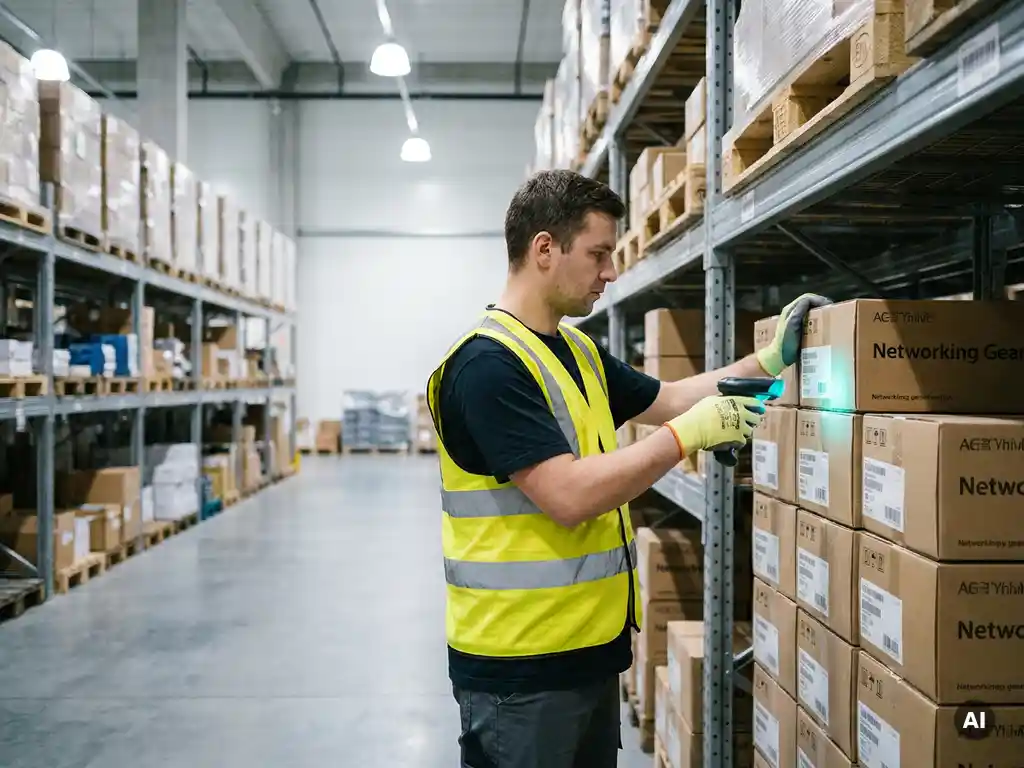
Fulfilment providers manage inbound shipments of technical products through a structured sequence of receiving, verification, registration, and preparation steps that ensure every item is accurately recorded and ready for storage or deployment. Unlike standard consumer goods, IT hardware and telecom equipment require product-level traceability, condition checks, and often technical preparation before they can enter active inventory. The sections below unpack each stage of that process in detail.
What happens to a technical product shipment when it arrives at a fulfilment warehouse?
When a shipment of technical products arrives at a fulfilment warehouse, it enters a structured goods receipt process. The shipment is booked in against an expected delivery, unloaded, and physically counted before anything is moved into storage. For IT hardware and telecom equipment, this initial stage is more rigorous than for standard consumer goods because individual product identification matters from the very first moment.
The receiving team cross-references the physical delivery against the purchase order or advance shipping notice. Quantities are confirmed, outer packaging is inspected for transit damage, and any discrepancies are flagged immediately. For palletised shipments of routers, modems, or networking equipment, this often means breaking down pallets to verify individual carton counts before proceeding to the next stage.
Once the initial count is confirmed, products are moved to a dedicated inbound processing area rather than placed directly into storage. This staging area is where more detailed verification and registration take place, keeping unprocessed goods separate from available inventory until they have been fully checked and recorded.
How do fulfilment providers verify the contents and condition of inbound technical goods?
Fulfilment providers verify inbound technical goods through a combination of quantity checks, visual inspection, and product-level registration. Each unit is examined for physical damage, completeness of accessories, and correct labelling. For technical products, this verification step is essential because a modem missing its power adapter or a device with a cracked casing cannot be dispatched to a customer or deployed in the field without first being assessed or corrected.
Verification typically covers three areas: quantity accuracy, packaging condition, and product completeness. Teams check that the number of units received matches the order documentation, that outer and inner packaging shows no signs of damage that could indicate product compromise, and that each product includes all expected components such as cables, brackets, or documentation.
Any shortages, overages, or damaged units are documented with supporting evidence and communicated to the client. This creates a clear record of the shipment’s condition at the point of receipt, which is important for supplier claims, insurance purposes, and accurate inventory management. Products that fail inspection are quarantined separately until a decision is made about repair, return to supplier, or disposal.
What is serialised tracking and why does it matter for inbound IT hardware?
Serialised tracking is the process of recording and managing each individual product unit using its unique serial number, rather than tracking stock purely by quantity or SKU. For inbound IT hardware, it matters because it creates product-level traceability from the moment a device enters the warehouse, enabling precise identification, location tracking, and history recording throughout the entire logistics chain.
When a shipment of networking equipment, set-top boxes, or IP telephones arrives, each device carries a manufacturer-assigned serial number. During inbound processing, these serial numbers are scanned and registered in the warehouse management system, linking each physical unit to its product record. From that point forward, the system knows exactly which specific device is in which location, what condition it was received in, and where it goes next.
This level of detail has significant practical consequences. If a device is later returned by a customer, the serial number immediately connects it to its original inbound record. If a firmware issue is identified with a specific batch of devices, serialised records make it possible to locate the affected units precisely. For telecommunications operators managing thousands of customer premises devices, or healthcare technology suppliers handling high-value medical equipment, this granularity is not optional: it is a fundamental operational requirement. Serialised inventory management reduces errors, supports warranty administration, and makes product recalls or targeted interventions far more manageable.
How do fulfilment providers handle technical preparation during the inbound process?
Some fulfilment providers integrate technical preparation directly into the inbound process, so that devices are configured, labelled, or assembled before they enter available inventory. This means products arrive at the warehouse and leave the inbound stage already prepared for deployment, resale, or direct shipment to an end user, without requiring a separate handling step later.
Technical preparation during inbound can include several types of activity depending on the product and the client’s requirements. Configuration files can be installed on routers or modems so they are ready for a specific network environment. Firmware can be updated to the latest approved version. Devices can be assigned to specific customer accounts or provisioned with the correct settings before storage. Labels, asset tags, or barcodes can be applied at this stage to meet client or end-customer requirements.
Integrating technical services into the inbound workflow reduces the total number of times a product is handled, which lowers the risk of damage and shortens the time between receipt and dispatch. For telecom operators deploying large volumes of customer equipment, this approach can significantly reduce the lead time between stock arrival and field readiness. It also means that technical errors are caught early, before a device reaches a customer or an engineer on site.
What data and reporting should a fulfilment provider share after inbound processing?
After inbound processing, a fulfilment provider should share a clear confirmation of what was received, registered, and made available in inventory. This includes the total number of units processed, any discrepancies between expected and actual quantities, the condition status of received goods, and confirmation of which serial numbers have been registered. This reporting gives clients an accurate, up-to-date picture of their stock without requiring them to be present at the warehouse.
Beyond the basic goods receipt confirmation, clients should have access to ongoing inventory visibility through the provider’s warehouse management system. This means being able to query current stock levels, view the location of specific serial numbers, and monitor product movements in real time. For businesses managing IT hardware across multiple product lines or serving multiple customer segments, this visibility is essential for planning, procurement, and customer service.
Reporting should also flag exceptions clearly. If units were quarantined due to damage, if serial numbers did not match documentation, or if quantities were short, these issues need to be communicated promptly with enough detail to act on. Transparent reporting at the inbound stage prevents discrepancies from compounding later in the fulfilment cycle, and it forms the foundation for reliable B2B fulfilment services downstream.
How BNS Data Logistics supports inbound fulfilment of technical products
BNS Data Logistics provides structured inbound logistics and fulfilment services specifically designed for businesses handling IT hardware, telecom equipment, and other technical products. The following capabilities are directly relevant to the inbound challenges discussed in this article:
- Goods receipt and quantity verification: Inbound shipments are received, counted, and cross-referenced against order documentation, with discrepancies recorded and communicated promptly.
- Condition inspection and quarantine management: Products are checked for physical damage and completeness during inbound processing, with non-conforming units separated and reported clearly.
- Serial number registration: Individual devices are scanned and registered in Cosmos, BNS’s proprietary warehouse management and product information system, creating product-level traceability from the moment of receipt.
- Technical preparation during inbound: Configuration files, firmware updates, labelling, and device provisioning can be performed as part of the inbound workflow, reducing handling steps and shortening time to deployment.
- Real-time inventory visibility: Clients gain access to current stock information, serial number locations, and inbound reporting through Cosmos, without needing to contact the warehouse directly for routine queries.
- Integrated reverse logistics: Returns can be processed and reintegrated into inventory where appropriate, with the same level of product-level tracking applied during inbound.
If your business handles inbound shipments of technical products and you want a fulfilment partner with the processes and systems to manage them accurately, contact BNS Data Logistics to discuss your specific requirements at bnsdl.com/contact.
Related Articles
- How can businesses track which electronic devices were delivered to each customer?
- How does serialized inventory management improve supply chain visibility?
- How can technology manufacturers outsource warehousing and order fulfilment in Europe?
- What are the benefits of outsourcing IT equipment fulfilment?
- What should internet service providers look for in a fulfilment partner?