
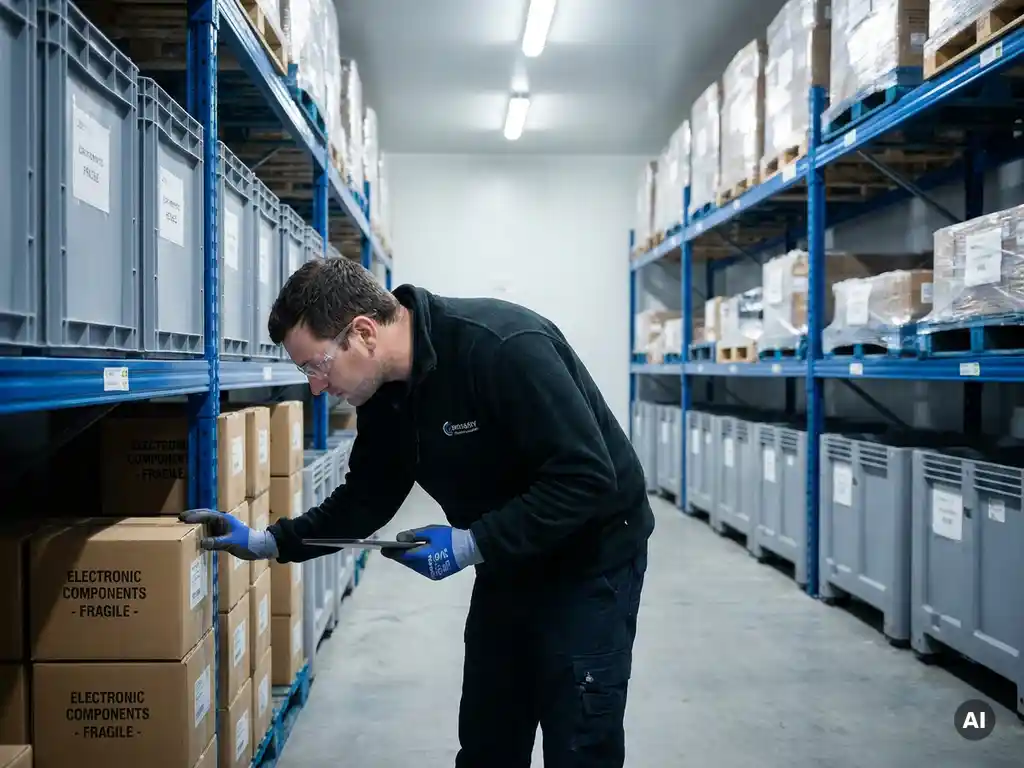
Warehousing electronic devices is significantly more complex than storing standard consumer goods. Electronics require precise environmental controls, individual-level tracking, careful handling, and structured processes for returns and end-of-life management. These demands apply to any business managing IT hardware, telecom equipment, or connected devices at scale. The questions below unpack the specific challenges that make electronics warehousing a specialist discipline.
Why is electronics warehousing more complex than general warehousing?
Electronics warehousing is more complex than general warehousing because electronic devices require individual-level traceability, controlled storage conditions, technical preparation before shipment, and structured returns processing. Unlike standard goods, each unit often carries a unique serial number, firmware version, or configuration state that must be tracked and managed throughout its time in the warehouse.
General warehousing typically operates on a unit or SKU basis: a box of pens is a box of pens. With IT equipment and telecom hardware, a router is not simply a router. It may carry a specific firmware version, a pre-loaded configuration file, or a warranty status that distinguishes it from an identical-looking unit on the shelf next to it. Managing this level of product complexity demands more sophisticated processes, more precise record-keeping, and staff with a working understanding of the products they handle.
The range of products involved also adds operational complexity. A single fulfilment operation might handle routers, modems, IP telephones, fibre-optic accessories, and medical-grade electronic equipment simultaneously, each with different storage requirements, handling procedures, and outbound preparation steps. Scaling this kind of operation without introducing errors requires both disciplined warehouse processes and capable technology systems.
How does inventory accuracy become a problem with electronic devices?
Inventory accuracy becomes a problem with electronic devices because standard barcode or SKU-level tracking is often insufficient. Many electronics must be tracked at the individual serial number level, meaning a warehouse management system needs to record not just how many units are in stock, but precisely which units, their condition, and their configuration status.
When serial number tracking is absent or inconsistently applied, stock discrepancies emerge quickly. A device may be received, logged at SKU level, and later shipped without anyone recording which specific unit left the building. This creates problems downstream: warranty claims cannot be verified, recalled products cannot be located, and returned items cannot be matched to their original shipment record.
For businesses operating in telecom equipment fulfilment or IT equipment fulfilment, the consequences of poor inventory accuracy go beyond internal inconvenience. Customers receiving the wrong device, a unit with outdated firmware, or a product that should have been quarantined will experience service disruptions. Recovering from these errors is costly and time-consuming. Serialised inventory management addresses this by assigning a unique identity to each product from the moment it enters the warehouse, enabling accurate, real-time tracking at every stage.
What environmental and handling risks affect stored electronics?
Stored electronics face environmental risks including electrostatic discharge, temperature and humidity fluctuations, physical impact, and dust exposure. Any of these can damage sensitive components without leaving visible external signs, meaning a device may appear intact while its internal circuitry has already been compromised.
Electrostatic discharge is one of the most underestimated risks in electronics warehousing. A static charge that a person cannot even feel can destroy microprocessors, memory chips, and circuit boards. Proper storage requires anti-static packaging, grounded workstations, and trained staff who understand how to handle sensitive hardware without introducing this risk.
Temperature and humidity control matters particularly for long-term storage. Excess moisture can cause corrosion on connectors and circuit boards, while extreme heat accelerates component degradation. High-value or sensitive equipment, including medical technology devices, demands storage environments that maintain stable conditions rather than simply providing covered space.
Physical handling also carries risk. Electronics are often heavier, more fragile, or more irregularly shaped than standard consumer goods. Improper stacking, inadequate packaging, or rushed picking processes can result in damaged screens, broken connectors, or cracked housings that are only discovered when a customer opens the box. Specialist electronics warehousing builds handling protocols around these realities from the outset.
How do returns and refurbishment add complexity to electronics warehousing?
Returns and refurbishment add complexity to electronics warehousing because returned devices cannot be treated as a uniform category. Each returned item must be individually inspected, assessed for condition, tested for functionality, and routed through the appropriate process, whether that is restocking, repair, refurbishment, or responsible disposal.
Unlike a returned item of clothing, a returned modem or set-top box may carry customer data, a non-standard configuration, or a firmware version that is no longer current. Before any returned device can re-enter available inventory, it needs to be wiped, inspected, and potentially reconfigured. Skipping these steps creates downstream problems ranging from data security incidents to customer complaints about receiving a device that does not work as expected.
The volume and variability of returns in telecom and IT environments make this particularly demanding. Operators managing thousands of returned routers or handsets need a structured returns management process with clear decision trees for each product condition category. Without this, returned stock accumulates, residual value is lost, and disposal costs rise. Where refurbishment is viable, integrating technical restoration directly into the reverse logistics workflow reduces unnecessary transportation and shortens the time before a product can be reused or resold.
What compliance and security requirements apply to electronic device warehousing?
Electronic device warehousing is subject to compliance and security requirements covering data protection, product safety, waste management, and information security. The specific obligations depend on the product type, the markets served, and the nature of the data the devices may carry, but all businesses handling electronic equipment at scale need to address these areas systematically.
Data security is a primary concern. Devices that have been in use, whether returned by end customers or recovered from corporate deployments, may contain personal or commercially sensitive data. A warehouse handling such products needs clear procedures for secure data erasure and must be able to demonstrate that these procedures have been followed. ISO 27001 certification is one recognised framework for managing information security risks in this context.
Environmental compliance adds another layer. Electronic waste is regulated across Europe under the WEEE Directive, which sets obligations for the collection, treatment, and reporting of end-of-life electrical and electronic equipment. Businesses that warehouse and process electronics need to understand where their responsibilities begin and end within this framework, particularly when products are being assessed for disposal rather than reuse.
Product safety regulations, including CE marking requirements and restrictions on hazardous substances under RoHS, are also relevant for businesses involved in distributing or preparing electronics for sale. Warehouses that perform value-added activities such as repackaging, relabelling, or assembly must ensure these processes do not inadvertently affect product compliance. Maintaining ISO 9001 certification provides a structured approach to quality management that supports consistent compliance across these activities.
How BNS Data Logistics supports electronics warehousing
BNS Data Logistics provides specialist warehousing and logistics services designed specifically for businesses managing IT hardware, telecom equipment, and other electronic devices. The challenges described throughout this article are central to what BNS addresses on a daily basis for its clients.
- Serial number tracking: BNS registers and tracks each device at the individual unit level using its proprietary Cosmos warehouse management system, providing real-time inventory visibility and full product traceability from inbound receipt to outbound shipment.
- Controlled storage and careful handling: Products are stored and handled according to their specific requirements, with appropriate procedures in place for sensitive electronic equipment to reduce the risk of damage during storage and order processing.
- Technical preparation: BNS integrates device configuration and repair directly into its logistics operations, including firmware updates, configuration-file installation, diagnostics, and cosmetic restoration, so devices leave the warehouse ready for deployment or resale.
- Structured returns processing: Each returned device is individually inspected, assessed, and routed through the appropriate process, whether restocking, repair, refurbishment, or disposal, with reporting to maintain visibility throughout.
- Compliance-aware operations: BNS holds ISO 9001, ISO 14001, and ISO 27001 certifications, supporting clients who need a logistics partner with documented quality, environmental, and information security management practices.
- Scalable B2B fulfilment services: Whether managing steady-state distribution or seasonal volume peaks, BNS provides flexible warehousing and order fulfilment capacity without requiring clients to invest in additional infrastructure.
If your business is managing the complexities of electronics warehousing and looking for a partner with the processes and technical capability to support you, contact BNS Data Logistics to discuss your requirements.
Related Articles
- Why do internet service providers need customized packaging and device kitting?
- What are the advantages of real-time inventory reporting for telecom operators?
- How can businesses track which electronic devices were delivered to each customer?
- How can international companies distribute IT equipment across Europe without their own warehouse?
- How can technology companies improve the fulfilment of serialized products?