
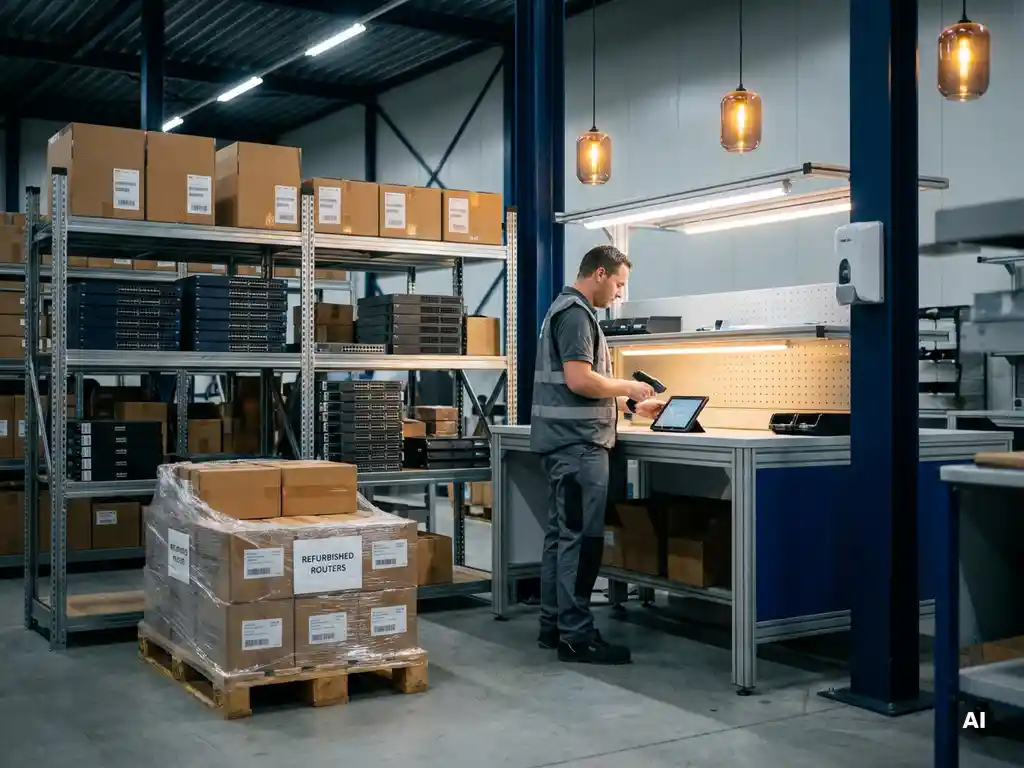
Combining IT fulfilment and reverse logistics under a single operational framework reduces costs, improves inventory accuracy, and shortens the time between a product being returned and it re-entering the supply chain. For B2B technology companies managing hardware at scale, this integrated approach eliminates the inefficiencies that arise when fulfilment and returns are handled by separate providers with disconnected systems. The sections below unpack the specific operational, financial, and sustainability benefits of bringing these two processes together.
What operational benefits come from integrating IT fulfilment with reverse logistics?
Integrating IT fulfilment with reverse logistics creates a single, coordinated workflow where returned products are received, assessed, and reintegrated into available stock without leaving the operational environment. This eliminates handover delays, reduces data gaps between inbound and outbound processes, and gives logistics teams a complete view of product movements across the entire supply chain.
When fulfilment and returns are managed by separate providers, each operates with its own systems, its own inventory records, and its own reporting timelines. A router returned by a customer on Monday may not appear in the fulfilment provider’s stock records until days later, if at all. In an integrated model, that same device is received, inspected, and registered within the same warehouse management system used for outbound orders. The result is accurate, real-time inventory visibility across both directions of the supply chain.
Serialised inventory management plays a particularly important role here. Technology products such as modems, routers, and networking hardware are typically tracked by individual serial number. When fulfilment and reverse logistics share a single system, each device can be traced from initial dispatch through to return, inspection, and redeployment. This level of traceability reduces stock discrepancies, supports warranty and compliance processes, and makes it significantly easier to identify patterns in product returns.
Operationally, integration also reduces the number of handovers in the logistics chain. Fewer handovers mean fewer opportunities for errors, delays, or lost documentation. For businesses managing large volumes of technology hardware, this translates into more reliable order fulfilment and more predictable returns processing.
How does a combined approach reduce logistics costs?
A combined approach reduces logistics costs primarily by eliminating duplication. When fulfilment and reverse logistics share the same warehouse infrastructure, the same staff, and the same systems, businesses avoid paying twice for storage, handling, and administration. Consolidated transport routes, shared receiving processes, and unified reporting also reduce the overhead associated with managing two separate provider relationships.
One of the most significant cost drivers in technology logistics is unnecessary product movement. When returns are processed by a separate provider, returned hardware often needs to be transported to a different facility before it can be inspected, repaired, or restocked. Each additional movement adds cost and time. In an integrated model, returned equipment is handled in the same location as outbound fulfilment, which reduces transport requirements and shortens the overall returns cycle.
There are also cost benefits related to inventory efficiency. Returned products that can be refurbished or repackaged re-enter available stock more quickly, reducing the need to purchase replacement units. While the extent of these savings depends on the condition of returned equipment and the specific product type, faster reintegration consistently reduces the gap between a product being returned and it generating value again.
Administrative costs also decrease when a single provider manages both functions. Consolidated reporting, unified invoicing, and a single point of contact reduce the management overhead that comes with coordinating multiple logistics partners. For procurement directors and operations managers evaluating value-added logistics, this simplification often represents a meaningful operational improvement.
What happens to returned IT equipment when fulfilment and reverse logistics are managed together?
When fulfilment and reverse logistics are managed within the same operation, returned IT equipment follows a structured process: receipt and registration, condition assessment, sorting, and then a decision on the most appropriate next step. That next step might be direct reintegration into stock, refurbishment, repair, or, where the product cannot be recovered, responsible disposal.
The first stage is receiving and registering the returned item against its original serial number or order reference. This connects the return to the outbound record, which is essential for warranty tracking, asset management, and accurate inventory accounting. In a reverse logistics operation integrated with fulfilment, this registration happens within the same system used to manage outbound stock, so inventory records update in real time.
Once registered, the product is assessed. For technology hardware, this typically involves a visual inspection and, where appropriate, functional diagnostics. The outcome of this assessment determines what happens next. Products in good condition may be repackaged and returned to available inventory immediately. Devices with minor cosmetic issues or outdated firmware may require restoration or configuration work before they are suitable for redeployment. Products with technical faults may need repair.
It is important to note that not every returned product can be refurbished or resold. The outcome depends entirely on the condition of the device and the nature of the fault. What integration does is ensure that each product is assessed systematically and routed to the most appropriate process, rather than sitting in a returns queue with no clear next step.
How does an integrated model support circular economy goals?
An integrated fulfilment and reverse logistics model supports circular economy goals by making it operationally practical to recover value from returned products rather than disposing of them. When the infrastructure for returns processing sits alongside fulfilment, businesses can assess, refurbish, and redeploy hardware more efficiently, extending product lifecycles and reducing the volume of equipment that reaches end of life prematurely.
The circular economy, in the context of technology logistics, is about keeping products in use for as long as possible. This requires more than good intentions. It requires the operational capability to receive returned equipment, determine its condition, carry out any necessary restoration, and reintegrate it into the supply chain. When these steps are fragmented across multiple providers, the friction involved often makes it easier to replace a device than to recover it.
Integration removes much of that friction. A modem returned by an internet service provider customer, for example, can be received, tested, reconfigured with updated firmware, and returned to stock for redeployment, all within the same facility and the same operational workflow. The technical services required to prepare that device for reuse are embedded in the logistics process rather than treated as a separate activity.
For sustainability directors and circular economy managers, this has practical reporting benefits as well. Consolidated data from a single provider makes it easier to measure refurbishment rates, track the proportion of returned equipment that avoids disposal, and demonstrate progress toward environmental objectives. These metrics are increasingly relevant for organisations with ESG commitments or regulatory reporting requirements.
Which types of businesses benefit most from combining IT fulfilment and reverse logistics?
Businesses that benefit most from combining IT fulfilment and reverse logistics are those managing high volumes of technology hardware with significant return flows. This includes telecommunications operators, internet service providers, IT hardware distributors, and e-commerce businesses selling electronics and networking equipment. The more complex the product and the higher the return volume, the greater the operational advantage of an integrated approach.
Telecommunications operators and internet service providers are a particularly strong fit. They routinely deploy large quantities of customer premises equipment, including routers, set-top boxes, and modems, and manage the return of that equipment when customers upgrade, churn, or experience faults. Coordinating these flows through a single integrated provider, with fulfilment services and returns management under one roof, significantly reduces operational complexity.
IT hardware distributors and manufacturers also benefit, particularly those managing serialised products across multiple sales channels. When individual devices need to be tracked from initial shipment through to potential return and redeployment, serial number tracking within a unified system provides the traceability that disconnected providers simply cannot offer.
E-commerce businesses selling technology products face a different but related set of challenges. Return rates in electronics can be substantial, and the cost of processing returns inefficiently erodes margins quickly. An integrated model helps these businesses process returns faster, recover more product value, and maintain accurate inventory records without building extensive internal logistics operations.
Healthcare technology suppliers managing medical devices also benefit from the structured, traceable approach that integration enables, particularly where product identification and delivery accuracy are critical requirements.
How BNS Data Logistics supports integrated IT fulfilment and reverse logistics
BNS Data Logistics provides an integrated operational framework that combines IT equipment fulfilment, returns management, technical services, and refurbishment within a single facility in the Netherlands. For B2B technology companies looking to consolidate their logistics operations, this means working with one partner across the entire product lifecycle rather than coordinating between multiple providers.
- Serialised inventory management: BNS uses its proprietary Cosmos warehouse management system to track technology products by individual serial number, providing real-time visibility across both outbound fulfilment and returned stock.
- Integrated returns processing: Returned hardware is received, inspected, and assessed within the same operational environment as outbound fulfilment, reducing delays and keeping inventory records accurate.
- Technical services embedded in logistics: Where returned or refurbished devices require configuration, firmware updates, diagnostics, or cosmetic restoration, BNS performs these processes on-site, avoiding unnecessary transportation and shortening the time to redeployment.
- Value recovery and circular logistics: Products assessed as suitable for reuse are refurbished and reintegrated into available stock, supporting circular economy objectives and reducing unnecessary replacement purchasing.
- Consolidated reporting: A single provider relationship means unified operational data, simplified invoicing, and clearer visibility into both fulfilment performance and returns outcomes.
The specific benefits depend on the nature of your products, your return volumes, and your current logistics setup. If you are evaluating whether an integrated approach makes sense for your business, the team at BNS Data Logistics is happy to discuss your requirements in practical terms. Get in touch to start the conversation.
Related Articles
- How can outsourced inventory management reduce operational costs for technology companies?
- How can businesses track which electronic devices were delivered to each customer?
- How can a warehouse management system improve the accuracy of IT equipment distribution?
- How can international companies distribute IT equipment across Europe without their own warehouse?
- How can telecom operators reduce errors in modem and router distribution?